- Mac Yosemite Access For Assistive Devices 2017
- Mac Enable Access For Assistive Devices
- Access For Assistive Devices Mac
- Mac Os Enable Access For Assistive Devices
- Mac Yosemite Access For Assistive Devices Mac
- Mac Yosemite Access For Assistive Devices Windows 10
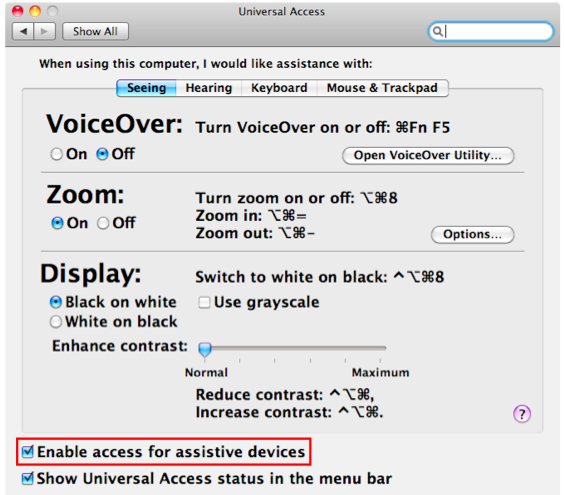
Jun 12, 2014 Using a bash script to enable access to assistive devices is possible in Mavericks (and also Yosemite) despite the move to a per-app database. This is useful for entering keystrokes or clicking GUI buttons via a bash script. Prior to OS X Mavericks, enabling access to. Jan 15, 2017 Top 5 Hidden Mac Tricks in macOS Sierra - Duration. DIY Perks Recommended for you. Accessibility on OS X Yosemite. How to enable 'Access to assistive devices' in OSX 10.10. Jul 26, 2014 An example of how to use this, would be to allow TextExpander 4 access to assistive devices: sudo tccutil.py -insert com.smileonmymac.textexpander sudo tccutil.py -insert com.smileonmymac.textexpander.helper. The solution above was not needed prior to Mavericks and Yosemite because a single command would enable all apps access to assistive. Mar 24, 2017 I'm not a programmer or anything, but I'd really like to use the app. I have selected 'Enable access for assistive devices' and opened the Noisy Typer app. The app did prompt me with a message reminder about how to turn the app off, but after clicking 'ok' I have yet to get any sound whatsoever from keyboard operations.
Every Mac is built with assistive technologies to support people who are blind or have low vision. The VoiceOver screen reader describes exactly what’s happening on your screen. Hover Text lets you instantly magnify a selection of text. And Display Accommodations support color blindness and other vision needs.
Hover TextGet a quick size boost of what you’re reading.
Hover Text makes it easier to view text on your display. If a paragraph, caption, or headline is too small to read, just hover over it with your cursor and press Command. You’ll get a dedicated window with a large, high-resolution version of your selection. You can even choose the fonts and colors that work best for you.
VoiceOverHear what’s happening on your screen.
VoiceOver does more than tell you what’s happening on your Mac. It helps you make things happen. It gives you auditory descriptions of each onscreen element and provides helpful hints along the way — whether you prefer using gestures, a keyboard, or a braille display. And it supports more than 35 languages, including multiple voice options.
VoiceOverIntegrated throughout macOS and every built-in app.
VoiceOver is unique because it’s not a standalone screen reader. It’s deeply integrated in macOS and all the built-in apps on Mac. And as developers update their apps to take advantage of the accessibility interfaces provided by Apple, their apps can start working with VoiceOver right away.
VoiceOverImproved PDF, web, and messages navigation.
We’ve refined VoiceOver to make it easier to navigate PDFs, websites, and messages. In Safari, improved conformance with HTML5 accessibility standards allows for more consistent navigation of websites. VoiceOver is now better at reading aloud tagged PDFs and email messages. If you start reading a website in a different language, VoiceOver can switch to the voice for that language automatically.¹ And you can add custom commands and workflows to your MacBook Pro with Touch Bar.
Audio DescriptionsHear the details in every scene.
Watch movies with detailed audio descriptions of every scene on your Mac. Movies with audio descriptions are displayed with the AD icon in the iTunes Store.
VoiceOverNavigate VoiceOver with simple gestures.
You can control VoiceOver using many of the same gestures you use with iOS. Touch the trackpad to hear a description of the item under your finger, drag to hear items continuously, and flick to move to the next item. Enable the VoiceOver Trackpad Commander, and the trackpad surface will represent the current window or document, so you can navigate quickly to any corner or edge with a tap.
VoiceOverA virtual controller with customizable commands.
VoiceOver features a virtual control called the rotor. Turning the rotor — by rotating two fingers on the trackpad as if you were turning an actual dial — lets you access an array of fully customizable commands. Use it to browse web pages more efficiently and intuitively. The rotor lists common elements like “headings,” “links,” and “images,” and lets you navigate directly to the element of your choosing.
VoiceOverPlug-and-play support for braille displays.
VoiceOver is the first screen reader to provide plug-and-play support for refreshable braille displays. Plug in or sync one of over 100 compatible displays, supporting more than 80 international tables, and the VoiceOver description is presented to you in braille. You can edit seamlessly in Grade 2 Braille, viewing your edits in the context of the actual line of text. Optimized for fast braille typists, VoiceOver makes working in braille easy and efficient. Converting between braille and text happens automatically so you see only Grade 2 Braille. And for sighted users who sit alongside you, there’s an onscreen braille panel that displays both braille and plain-text versions of the descriptions spoken by VoiceOver.
Dark ModeWorking hard gets easier on the eyes.
Dark Mode transforms the desktop and built-in apps with a dark color scheme that helps you focus on your work.2 The fine points of your content take center screen as toolbars and menus recede into the background. Light text against darker backdrops in Mail, Safari Reader, Calendar, and more makes everything easier to read in low lighting conditions. And the Accessibility preferences for increased contrast and reduced transparency work with Dark Mode enabled.
DictationYou say it. Mac types it.
Dictation lets you talk where you would type — and it works in over 40 languages. So you can reply to an email, search the web, or write a report using just your voice. Navigate to any text field, activate Dictation, then say what you want to write. macOS also comes with more than 50 editing and formatting commands. So you can turn on Dictation and tell your Mac to bold a paragraph, delete a sentence, or replace a word. You can also use Automator workflows to create your own Dictation commands.
SiriStreamline the things you do every day.
Siri helps you do more with your desktop.³ Ask Siri to send messages, track down files, create reminders, search the web, and even turn on and off VoiceOver and Invert Colors, without interrupting what you’re doing on the keyboard. And because Siri is integrated with VoiceOver, you can ask it to find a file and hear the answer read out loud. If you prefer to communicate by typing, you can easily set Siri to “Type to Siri” mode.
ZoomMake your screen up to 20 times bigger.
Zoom is a powerful built-in magnifier that lets you enlarge your screen up to 20 times, so you can better see what’s on the display. You can zoom using full screen or picture-in-picture, allowing you to see the zoomed area in a separate window while keeping the rest of the screen at its native size. A shortcut key lets you pan the screen without moving the pointer while zoomed in. macOS can also flash the screen for notifications offscreen or speak text under your pointer. The hardware acceleration engine lets you boost the size of anything on your screen — text on a web page, family photos, or a place on a map.
Zoom DisplaySee content up close and at a distance simultaneously.
Now with macOS Catalina, if you have two displays, you can keep one zoomed in close while the other stays at a standard resolution. So you can tackle everyday work or give a presentation more efficiently.
Cursor SizeMagnify your cursor so it’s easier to use.
macOS lets you magnify your cursor so it’s easier to see where you are and follow along as you move around your Mac. Set the cursor size once and it stays magnified even when its shape changes. And when you swipe back and forth on your trackpad or quickly shake your mouse, the pointer grows so it’s easier to locate.
Contrast and Color OptionsInvert colors or enable color filters.
macOS lets you invert colors, enable grayscale, or choose from a range of color filters to support different forms of color blindness or other color vision deficiencies. You can select a common preset or fine-tune the color tint and hue to customize a display setting that works for you.
Reduce MotionDecrease the movement of onscreen elements.
Mac Yosemite Access For Assistive Devices 2017
If you’re affected by the motion of screen elements, you can turn on Reduce Motion to decrease movement in areas like Spaces, Notification Center, and the Dock.
Music, Podcasts, Books and TVNavigate and play with VoiceOver.
The Apple Music, Apple Podcasts, Apple Books, and Apple TV apps are compatible with VoiceOver, so you can navigate and play all your content even if you can’t see the screen. Browse the apps as VoiceOver reads out headers, links, and other elements on the page.
Resources
Support
User Guides
Or order an embossed copy of macOS VoiceOver User Guide
External Resources
Hadley Institute for the Blind and Visually Impaired
Explore instructional videos with tips on using vision accessibility features in macOS.
Learn more about the Hadley Institute instructional videos at their websiteJoin a community of blind and low-vision users of Apple products.
Learn more about AppleVis.com at their websiteGet information on the use of Apple products by those who are blind or low vision.
Learn more about Mac-cessibility Network at their websiteMac Enable Access For Assistive Devices
Lesson 2: New Features in OS X Yosemite
/en/macosxyosemite/os-x-yosemite-frequently-asked-questions/content/
New features in OS X Yosemite
Perhaps you just bought a Macintosh computer that includes OS X Yosemite. Or maybe you've recently upgraded to Yosemite from a previous version of OS X (pronounced O-S ten). On the other hand, you may be a Windows user who is considering switching to a Mac. No matter your situation, in this lesson we'll show you some of the many new features in OS X Yosemite.
Yosemite is similar to previous versions of OS X. If you're new to OS X, or if you just want to review the basics, check out our OS X Basics tutorial.
Access For Assistive Devices Mac
What is Mac OS X Yosemite?
OS X Yosemite (version 10.10) is the most recent operating system designed by Apple and released in 2014. It is generally used with Apple Macintosh computers (Macs). Like other operating systems, it allows you to run programs, organize your files, browse the Internet, and more.
Mac Os Enable Access For Assistive Devices
Although Yosemite is new, other versions of Mac OS X have been around for years. Previous versions include Mavericks (version 10.9), Mountain Lion (10.8), Lion (10.7), and Snow Leopard (10.6). If you are upgrading from OS X Mavericks or Mountain Lion, Yosemite will be a relatively minor upgrade.
The most significant change in Yosemite is its interface. Compared with earlier versions, Yosemite has a simpler, flatter look. In many ways, the design is similar to iOS, the operating system used by the iPhone and iPad. The built-in apps have also been redesigned to be more streamlined. For example, many toolbars have been streamlined to save space, which should be especially helpful for laptops with smaller screens.
An operating system manages all of the hardware and software on a computer. Without it, the computer would be useless. To learn more about how operating systems work, check out Understanding Operating Systems in our Computer Basics tutorial.
New features in OS X Yosemite
Each new version of OS X usually includes a lot of new features, and OS X Yosemite is no exception. Below are some of the most important changes and features.
Apple disclaims any and all liability for the acts, omissions and conduct of any third parties in connection with or related to your use of the site. Best version of macos for retina 15-inch late 2013 model. Apple may provide or recommend responses as a possible solution based on the information provided; every potential issue may involve several factors not detailed in the conversations captured in an electronic forum and Apple can therefore provide no guarantee as to the efficacy of any proposed solutions on the community forums.
- Connecting with iOS devices: If you have an iPhone, iPad, or iPod Touch, OS X Yosemite will recognize your device when it is nearby. With some tasks, you can seamlessly switch from your computer to your device with a new feature called Handoff. For example, if you're typing an email on your Mac, you can finish typing it on your iPhone. Handoff works with many built-in apps and some third-party apps, but it won't work with all apps. Note that Handoff will not work with computers from 2011 or earlier.
- Internet tethering: If you use your laptop on the go, you typically need to find a Wi-Fi hotspot to access the Internet. However, if you have an iPhone or iPad with a data plan, you can now share the device's Internet connection with your laptop. This feature is commonly known as tethering, although in OS X Yosemite it is called Personal Hotspot. Keep in mind that if you have a limited amount of data for your iOS device, you may only want to use this feature for basic Internet usage; streaming movies and music can quickly use up your monthly data allotment.
- Spotlight improvements: As in earlier versions, Spotlight can be used to search for files, folders, apps, and more. In OS X Yosemite, Spotlight has been completely redesigned. Instead of a simple menu, it now opens in a larger dialog box to make it easier to perform searches.
- iCloud Drive: You can now easily access iCloud from any Finder window. If you want to store a document or other file in the cloud, you can simply drag the file to the iCloud folder and it will be automatically uploaded.
Upgrading from an earlier version of OS X?
If you're upgrading from Snow Leopard or an earlier version of OS X, you should be aware of some features that were introduced in Lion, such as Mission Control and Launchpad.
Mac Yosemite Access For Assistive Devices Mac
Mission Control allows you to view all of the documents and applications that are open, and it also allows you to switch between different virtual desktops. Launchpad makes it easy to open and manage your applications.
Mac Yosemite Access For Assistive Devices Windows 10
One of the most notable new features in Mountain Lion was the Notification Center. It keeps track of all of the alerts you receive for upcoming calendar appointments, tweets, news feeds, and other application events.
/en/macosxyosemite/upgrading-to-os-x-yosemite/content/